

The Numbers on Your Egg Carton Aren’t All Expiration Dates — Here’s What They Really Mean
You pick up a carton of eggs at the grocery store and notice a collection of numbers and letters printed along the side.
Maybe there’s a date.
Maybe there’s a code beginning with the letter “P.”
And then there’s a small three-digit number that looks almost like a secret code.
For years, many shoppers have assumed that these markings are simply different versions of an expiration date. But that isn’t quite how they work.
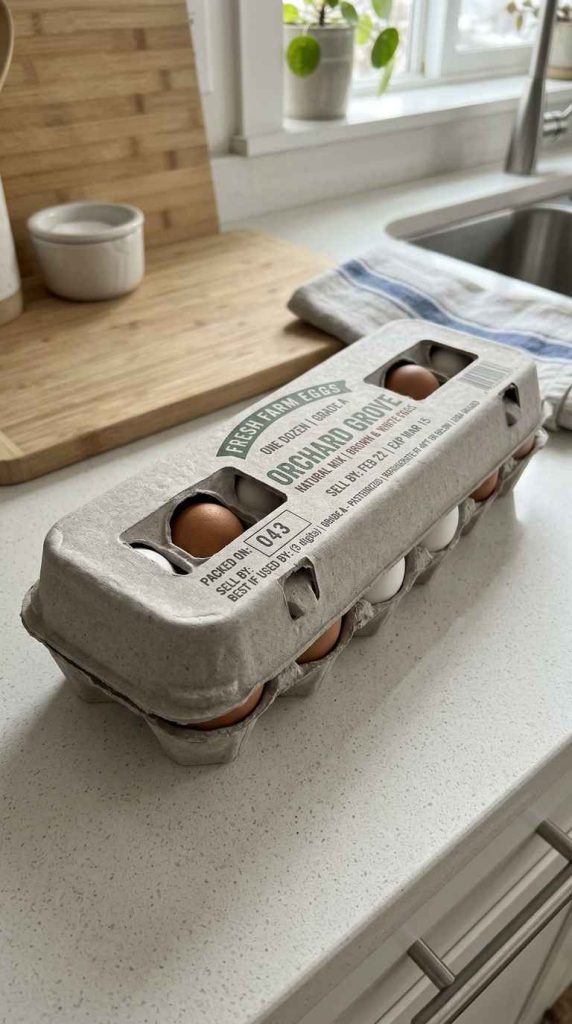
On many egg cartons in the United States, that three-digit number has a very specific purpose: it tells you the date the eggs were packed.
The system uses numbers from 001 to 365, with 001 representing January 1 and 365 representing December 31 in a non-leap year.
So if you see 032, for example, that corresponds to February 1. A code such as 198 represents July 17 in a non-leap year.
Once you understand the system, that little number suddenly becomes much more useful.
It can help you compare cartons, understand how recently eggs were packed, and decide which carton you may want to use first.
But there’s another important detail.
The pack date isn’t the same thing as a safety date.
What Does the “P” Code Mean?
The three-digit number isn’t the only marking worth understanding.
You may also notice a code beginning with the letter P followed by additional numbers or letters.
This generally identifies the processing or grading plant associated with the eggs.
In other words, these markings provide information about where and when the eggs were handled rather than simply telling you, “Eat these before this exact day.”
That distinction matters because egg cartons can contain several different types of dates and codes, and each one serves a different purpose.
A “Sell By” date is primarily useful for retailers managing inventory.

A “Best By” or “Best Before” date generally relates more closely to expected quality.
Neither should automatically be interpreted as a moment when an egg suddenly becomes unsafe.
The condition of the eggs, how they were stored, and how long they’ve remained properly refrigerated are also important.
Why the Pack Date Can Be Useful
Imagine you’re standing in a grocery store with two cartons in front of you.
Both have similar best-by dates, but one has a lower pack-date number.
That information can give you a better idea of which eggs were packed earlier.
It can also be useful when organizing your refrigerator at home.
If you have several cartons, understanding the pack dates can help you follow a simple first-in, first-out approach—using older eggs before newer ones whenever practical.
It’s a tiny bit of information that can make the markings on an egg carton much less confusing.
How Long Do Eggs Usually Last?
According to USDA guidance, raw shell eggs generally keep for approximately three to five weeks when properly refrigerated at 40°F (4°C) or below.
Keeping eggs in their original carton is also helpful.
The carton protects the shells and can reduce the effects of temperature changes. For best temperature stability, eggs are generally better kept on an interior refrigerator shelf rather than in the refrigerator door.
But there’s an important distinction to remember:
Freshness and safety aren’t exactly the same thing.
An older egg may still be usable if it has been properly stored, while an egg exposed to unsafe conditions can become a concern even if the date printed on the carton looks reassuring.
That’s why the carton code should be treated as useful information—not as a guarantee.
What About the Famous Water Test?
You’ve probably heard of the trick where you place an egg in a glass of water.
If it sinks, it’s supposedly fresh.
If it floats, it’s old.

There is some truth behind why this happens, but the test is often misunderstood.
As an egg ages, the air cell inside it becomes larger. That can eventually make the egg more likely to float.
However, the float test doesn’t prove that an egg is safe to eat.
It tells you something about the egg’s age, not whether harmful bacteria are present.
So if you’ve been relying on the water test as your main food-safety check, it’s better to think of it as a rough freshness indicator rather than a safety test.
Proper Storage Matters More Than a Mysterious Number
The most useful habit is surprisingly simple: keep eggs cold.
Store them consistently in a refrigerator maintained at 40°F (4°C) or below.
Try to avoid repeatedly leaving eggs out on the counter and then returning them to the refrigerator.
You should also pay attention to the condition of the shells.
If an egg is cracked, leaking, or heavily contaminated, it’s better to take a cautious approach rather than assuming the printed date makes it safe.
And whenever you’re handling raw eggs, remember basic kitchen hygiene.
Wash your hands after touching raw eggs, and clean utensils, countertops, cutting boards, and other surfaces that come into contact with them.
That helps reduce the possibility of cross-contamination.
What Changes After You Cook the Eggs?
The storage clock changes once eggs are cooked.
The FDA recommends cooking eggs until both the whites and yolks are firm.
Cooked egg dishes generally keep for about three to four days in the refrigerator.
Hard-cooked eggs can usually be refrigerated for approximately one week.
So if you’ve prepared a large batch of hard-boiled eggs for breakfasts or snacks, labeling the container with the preparation date can be a simple way to keep track of them.
The Small Code That Suddenly Makes Sense
Egg cartons can look confusing because several different pieces of information appear together.
But once you know what you’re looking at, the markings become much easier to understand.
The three-digit number can tell you when the eggs were packed.
The “P” code generally identifies the processing or grading plant.
A “Sell By” date helps retailers manage inventory.
A “Best By” date is more closely connected to expected quality.
And none of these markings should be considered a substitute for proper refrigeration and safe food handling.
So the next time you reach into the refrigerator and see a strange three-digit number on your egg carton, don’t assume you’ve found another expiration date.
You’ve actually found a small piece of information about the egg’s journey—from processing and packing to your refrigerator.
And once you understand what those numbers mean, that mysterious little code isn’t mysterious anymore.
💜📖 Love stories like this?
✨ Join Women With Stories for more powerful, emotional, and unforgettable stories shared every day. 💜
👥 Inspiring Stories
💜 Supportive Community
🌱 Real Connections
0 Comments