

I Found a Strange Kitchen Tool in My New Home—and It Made Me Curious About the People Who Lived There Before
When I opened the kitchen drawer in my new home, I expected to find the usual collection of forgotten utensils, loose measuring spoons, and things that previous owners had probably meant to throw away.
Instead, I found something I couldn’t identify.
It was a small metal object with an unusual shape, a sturdy handle, and several curved pieces that seemed carefully designed to fit together. It didn’t look like any kitchen gadget I had seen in a modern store. There was no label, no instruction booklet, and certainly no obvious explanation of what it was supposed to do.
I turned it over in my hands, hoping a closer look would reveal its purpose. It didn’t.
At first, I assumed it was nothing more than an outdated kitchen tool that had been forgotten during the previous owners’ move. But something about its construction made me hesitate before putting it in the trash.
Someone had chosen this object, brought it into the house, and kept it in a drawer where it could be reached whenever it was needed. That small detail made me wonder about the person who had owned it.
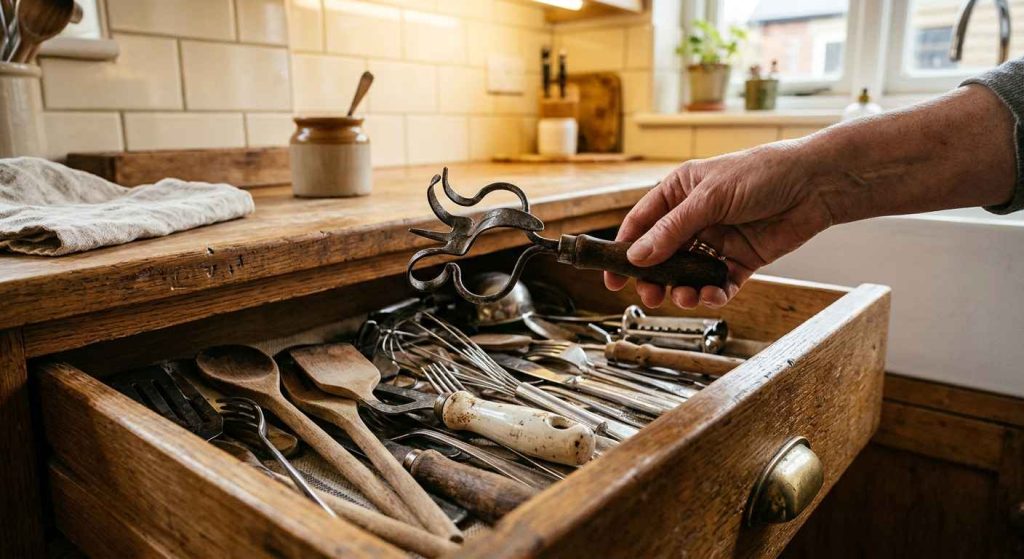
What had it been used for? How old was it? And why had nobody taken it along when they left?
I had moved into the house expecting a few ordinary surprises. I hadn’t expected a simple kitchen drawer to make me curious about a stranger’s life.
An Unexpected Discovery During an Ordinary Move
Moving into a new house involves hundreds of small decisions. There are boxes to unpack, cupboards to organize, furniture to arrange, and countless items that somehow never seem to have an obvious place.
My kitchen was no different.
I spent the first few days sorting plates, stacking glasses, and deciding which drawers would hold the things I used most often. The previous occupants had left the house in reasonably good condition, but a few forgotten belongings remained tucked away in cabinets and storage spaces.
Most were easy to explain. An old measuring cup belonged with the baking supplies. A chipped mug could be recycled or discarded. A handful of mismatched utensils went into a box of items I planned to donate.
Then I discovered the strange metal tool.
It was unlike the other objects in the drawer. Its shape seemed too specific to be accidental, and it appeared to have been made for a particular task. Although it showed signs of age, it didn’t look completely useless.
I cleaned it carefully and examined it under the kitchen light. I checked the handle, looked between the metal sections, and tried to imagine how someone might have held it while preparing food.
Nothing seemed obvious.
I briefly considered throwing it away with the other unwanted items. After all, the house was mine now, and I wanted to keep the kitchen tidy rather than fill it with objects I couldn’t identify.
But curiosity won.
I decided to find out what it was before making a decision.
The Search for an Answer
My first step was to search online for vintage kitchen utensils.
I looked at photographs of old food-preparation tools, baking equipment, and metal gadgets that had disappeared from modern kitchens. Some looked vaguely similar, but none matched the object in my drawer closely enough to provide a confident answer.
I tried different descriptions, changing the words whenever a search produced nothing useful.
Was it a cutting tool? Something used for shaping pastry? A device for separating ingredients? Perhaps it had been designed for a particular recipe that people prepared more frequently decades ago.
Every possibility seemed reasonable for a moment, but I didn’t have enough evidence to settle on one.
I also learned something unexpected during the search: many older household tools were designed for jobs that modern appliances now perform more quickly. Some were made for specialized cooking techniques, while others were intended to help with tasks that today’s kitchens handle using inexpensive, widely available equipment.
A tool that looks strange today might once have been an ordinary part of someone’s daily routine.
That thought made the mystery even more interesting.
The object didn’t necessarily need to be rare, expensive, or historically important. It only needed to have belonged to someone who had once found it useful.
I took a few photographs and shared them with an online community interested in old household objects. I explained where I had found the tool and asked whether anyone recognized its design.
The first replies offered several possibilities. Some people suggested that it might be a discontinued baking utensil. Others thought it could have been used to prepare a particular type of food.
A few admitted that they had no idea.
I appreciated the suggestions, but I still couldn’t identify it with certainty. The experience reminded me that the internet can be a useful place to begin an investigation without necessarily providing a final answer.
For now, the tool remained a mystery.
What an Old Kitchen Can Tell Us
While I continued looking for clues, I began thinking about the kitchen itself.
The cabinets had clearly been used for years. A few shelves showed faint marks where containers had repeatedly been moved. The wooden drawer containing the tool had small scratches near the handle, perhaps from decades of opening and closing.
These details were ordinary signs of a well-used home, but they encouraged me to imagine the lives that had unfolded there.
Perhaps someone had prepared breakfast in that kitchen every morning before leaving for work. Maybe a parent had spent Sunday afternoons cooking for a large family. Perhaps the previous owner had enjoyed baking, preserving seasonal produce, or preparing traditional dishes passed down through generations.
I couldn’t know which, if any, of those possibilities was true.
Still, it was easy to imagine the kitchen as more than a collection of cupboards and appliances. It had been a place where people followed familiar routines, celebrated small occasions, and gathered around a table after long days.
A forgotten utensil could have been part of those routines.
Maybe it had been used every week. Maybe it belonged to an older relative and was kept long after its original owner passed it along. Or perhaps it had been purchased for one particular purpose and then pushed to the back of the drawer.
There was no way to know from the object alone.
That uncertainty was part of what made the discovery memorable.
When we enter an older home, we see the rooms as they exist today. We rarely think about the ordinary moments that took place there before we arrived. A strange object can provide a small reminder that every home has a history, even when much of that history has gone undocumented.
Why Some Old Objects Are Difficult to Identify
The more I searched, the more I understood why identifying vintage household items can sometimes be difficult.
Manufacturers change designs, discontinue products, and replace older models with newer versions. Small tools may have been sold locally, advertised in old catalogs, or manufactured by companies that no longer exist.
Other objects were handmade, modified by their owners, or passed between family members without any packaging or written instructions.
Over time, the information that once made their purpose obvious can disappear.
Even an experienced collector might need several photographs, accurate measurements, and details about the material before identifying an unfamiliar object. Two tools can look similar while serving completely different purposes.
That is why a confident identification should depend on reliable evidence rather than appearance alone.
An antique dealer, a museum collection, a historical catalog, or a knowledgeable collector may be able to provide useful information. Comparing the object’s construction with documented examples can also help narrow down the possibilities.
Until then, it is better to acknowledge uncertainty than to attach an exciting but unsupported story to an ordinary item.
I decided to keep searching, but I stopped expecting an immediate answer.
The mystery had become enjoyable in its own right.
More Than Something Left Behind
Eventually, I placed the metal tool in a small container with a few other unusual things I had found while unpacking.
It no longer looked like an annoying piece of clutter. Instead, it had become a reminder of the unexpected details that can make moving into an old house such a memorable experience.
I still hoped to discover its purpose. If I found a convincing match in an old catalog or someone provided a reliable identification, I would be delighted.
But I no longer felt that I had to solve the mystery immediately.
The experience had already taught me something about the way we value everyday possessions.
We often judge an object by how useful it is to us right now. If it doesn’t fit our routines, we may consider it outdated or unnecessary. Yet the same object might have been important to someone else because it made a difficult task easier, helped preserve a family recipe, or reminded them of a person they loved.
Its value doesn’t have to be financial.
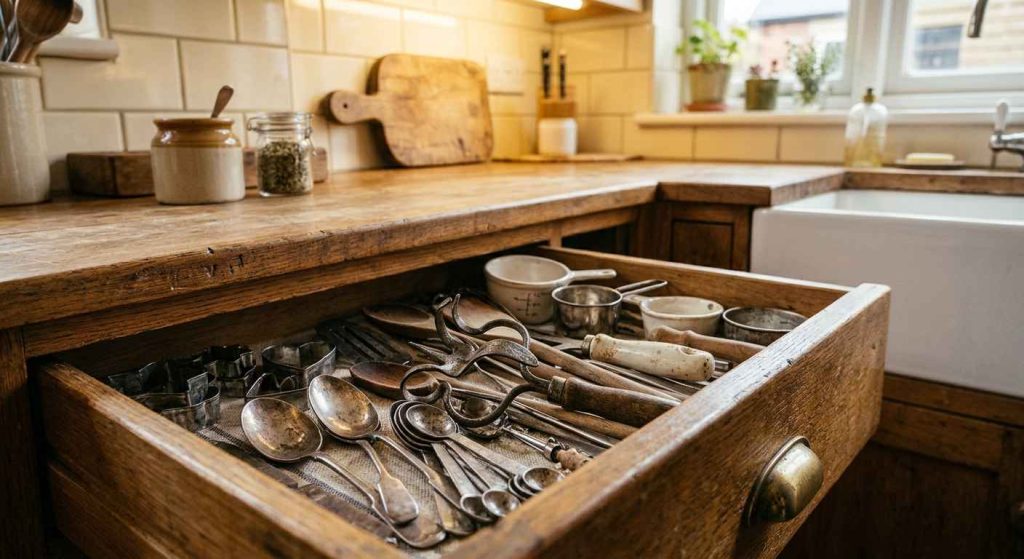
A worn wooden spoon, an old biscuit tin, or an unfamiliar kitchen gadget might carry memories that no price tag can measure. Of course, not every forgotten item has a remarkable story behind it. Sometimes an old utensil really is just an old utensil.
But we don’t always need a dramatic revelation to appreciate the possibility that an object has a history.
A Small Mystery With a Lasting Impression
These days, whenever I open that kitchen drawer, I sometimes notice the strange metal tool sitting among the ordinary utensils.
I still don’t know exactly what it was designed to do.
Perhaps one day, someone will recognize it immediately and explain its purpose in a few simple words. Perhaps I will find a photograph in an old catalog that finally answers my questions.
Until then, it remains an interesting little mystery in a house that is gradually becoming my own.
Moving into a new home is usually about creating a future: arranging furniture, establishing routines, and filling empty rooms with new memories. Yet occasionally, something left behind connects that future with a past we never experienced.
For me, that connection came from a small metal object hidden in a kitchen drawer.
It wasn’t a valuable discovery or a dramatic hidden treasure. It was simply an unfamiliar tool that made me pause and wonder about the people who had lived there before me.
And perhaps that is the most interesting part of the experience.
Sometimes, the smallest discoveries remind us that a home is more than walls, floors, and furniture. It is also a place where ordinary lives have unfolded, where familiar routines once mattered, and where even the simplest possessions may have been part of someone’s story.
I may never learn the complete history of the strange kitchen tool.
But I no longer see it as something that was merely left behind.
I see it as a small reminder that every old house holds traces of the people who came before us—and that curiosity can turn an ordinary discovery into something worth remembering.
0 Comments