

Rebuilding from Within: The Revolutionary Daily Pill That Could Reverse Osteoporosis
Osteoporosis is often referred to as the “silent thief.” For millions of aging adults worldwide, it sneaks up quietly, hollowing out the skeletal system over decades without causing a single symptom—until a sudden, unexpected fracture occurs. For years, a diagnosis of osteoporosis meant entering a lifelong defensive battle. The medical community’s primary strategy has been damage control: slow down the bone loss, manage the condition, and try to prevent further deterioration.
But the narrative surrounding bone health is on the verge of a historic rewrite. Thanks to a groundbreaking discovery by researchers in Japan, the medical dream of reversing osteoporosis might soon become a daily reality. An experimental daily pill currently in development promises to do the unthinkable—actively rebuild lost bone tissue.

For patients like Eleanor, a new daily pill could mean the difference between managing decline and restoring actual bone strength.
The Biology of Bone Maintenance: Builders vs. Demolishers
To truly understand why this new research from Tokyo Medical and Dental University is so revolutionary, we have to look closely at the hidden life of our skeleton. Despite its hard, stone-like appearance, bone is a highly active, living tissue that is constantly being broken down and rebuilt in a process called bone remodeling.
This endless construction cycle is managed by two specialized types of microscopic cells:
- Osteoblasts (The Builders): These cells are responsible for synthesizing and laying down fresh bone matrix, keeping our skeleton dense and strong.
- Osteoclasts (The Demolishers): These cells secrete enzymes and acids that dissolve old or damaged bone tissue, clearing the way for the builders.
In a healthy young adult, these two forces work in perfect equilibrium. However, as we age—particularly after menopause—hormonal changes and biological wear-and-tear disrupt this delicate balance. The “demolishers” begin working overtime, breaking down bone much faster than the “builders” can replace it. The dense, honeycomb-like structure inside the bone becomes porous, brittle, and fragile.
The Limitations of Current Medicines
Currently, the most common treatments for osteoporosis (like bisphosphonates) work primarily by targeting the osteoclasts. They effectively poison or disable the “demolishers,” slowing down bone resorption. While this stops the bleeding, so to speak, it doesn’t solve the core problem: it doesn’t build new bone.
“Stopping bone loss is only half the battle. To truly cure osteoporosis, we must find a way to switch the bone-building factories back on.”
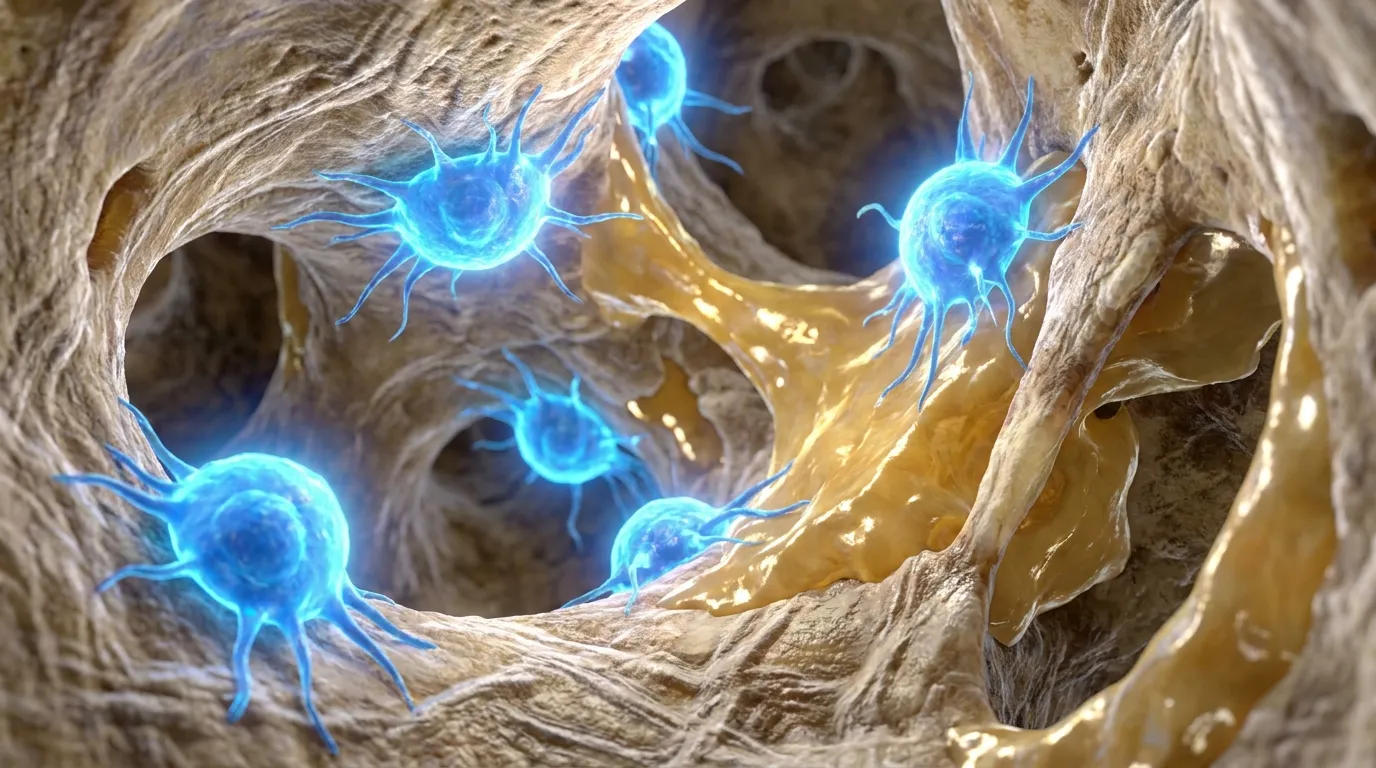
At a cellular level, the new treatment stimulates osteoblasts to lay down fresh, dense bone tissue.
Flipping the Master Switch: The GPR133 Receptor
The pioneering Tokyo research team set out to fix this imbalance by looking for a biological override switch. They found it in a specific protein pathway known as the GPR133 receptor.
G-protein coupled receptors (GPCRs) act like a cellular inbox, receiving messages from the body and telling the cell how to behave. By developing a compound that perfectly binds to and activates the GPR133 receptor, scientists have created a “message” that tells the body to reverse the osteoporosis cycle.
When this pill is introduced in preclinical studies, it performs a dual-action miracle:
- It supercharges the osteoblasts, forcing them to rapidly synthesize new bone tissue.
- It suppresses the osteoclasts, naturally cooling down the destructive breakdown process.
| Feature | Current Treatments (e.g., Bisphosphonates) | New GPR133 Breakthrough Pill |
|---|---|---|
| Primary Action | Slows down bone destruction | Actively builds new bone |
| Cellular Target | Inhibits Osteoclasts | Stimulates Osteoblasts & Inhibits Osteoclasts |
| Long-term Result | Preserves existing (often weakened) bone | Increases density, structure, and overall strength |
The Perfect Partnership: Mechanotransduction and Movement
While molecular biology is doing the heavy lifting at a cellular level, researchers discovered a fascinating synergy: this pill works significantly better when combined with physical exercise.
Bones are highly mechanosensitive. Through a process called mechanotransduction, our bones sense physical stress (like the pull of a muscle or the impact of walking) and respond by fortifying themselves in those exact high-stress areas. Early findings indicate that when the chemical activation of the GPR133 receptor is paired with resistance training, the results are exponentially amplified.

Combining the GPR133 treatment with resistance exercise provides a powerful, two-pronged approach to skeletal health.
By lifting weights or engaging in weight-bearing exercises, patients are essentially giving the newly awakened osteoblasts a blueprint of exactly where to lay down the strongest new bone. Together, the pill and the exercise could offer a comprehensive strategy for maintaining profound strength and mobility as we age.
Looking Ahead: Realistic Expectations and the Road to Approval
As with all major medical breakthroughs, it is vital to balance our immense hope with clinical realism. The scientists behind this marvel are quick to emphasize that this is not an overnight cure available at your local pharmacy tomorrow.
Currently, the bulk of this research remains in the rigorous preclinical testing stages. For this daily pill to become a standard prescription, several milestones must still be achieved:
- Extensive Human Trials: Expanding beyond laboratory models to real-world patient testing.
- Long-Term Safety Profiling: Ensuring that over-stimulating bone growth doesn’t carry unintended side effects elsewhere in the body.
- Dosage Optimization: Finding the exact biological “sweet spot” for maximum regeneration with minimum risk.

While human trials are still ongoing, the future of osteoporosis treatment has never looked brighter.
Despite the hurdles that remain, the trajectory of this research marks a monumental shift in medical science. We are officially transitioning away from an era of merely managing inevitable decline, and stepping into a future where rebuilding our strength from the inside out is entirely possible. The future of bone health is not just about survival—it is about profound, structural regeneration.
If you found this article interesting, please SHARE it with your friends and family!
Note: All images used in this article are AI-generated and intended for illustrative purposes only.
0 Comments